From April 1945 until Joe Biden's first/only (pick one) term as president ends
a few months from now, 80 years will have elapsed. During this period the U.S. has had 14 presidents, seven of them Democrats and seven of them Republicans. Here they are:
Democrats:
1. Harry S. Truman (1945-1953)
2. John F. Kennedy (1961-1963)
3. Lyndon Johnson (1963-1969)
4. Jimmy Carter (1977-1981)
5. Bill Clinton (1993-2001)
6. Barack Obama (2009-2017)
7. Joe Biden (2021-2025)
Republicans:
1. Dwight D. Eisenhower (1953-1961)
2. Richard Nixon (1969-1974)
3. Gerald Ford (1974-1977)
4. Ronald Reagan (1981-1989)
5. George H.W. Bush (1989-1993)
6. George W. Bush (2001-2009)
7. Donald Trump (2017-2021)
A closer look reveals that Democrats have held the presidency for 40 of those years and Republicans have held the presidency for the remaining 40 of those years. So it's been half and half, back and forth, six (well, seven) of one and a half-dozen (well, seven) of the other.
What does it prove? Probably nothing, but possibly that American voters are not paying attention, or possibly (and this is my view) that American voters are more than willing to give the other guys a chance but are also more than willing to throw the bums out if accomplisments do not live up to promises.
Let's change the subject.
All my life, including through the recent covid-19 pandemic, I believed that my wearing a mask prevented me from getting what another person might have. It turns out that I was wrong. My wearing a mask does not prevent me from getting what another person might have, it prevents the other person from getting what I might have. In order for me not to get what another person might have requires that the other person wear a mask.
No, really. My mask protects you, not me, and your mask protects me, not you. It boggles the mind. The logical conclusion is that we have to depend on one another in order to survive. What a concept!
In other news, former Secretary of State, former Senator from New York, former First Lady, and former Democrat candidate for president in 2016, Hillary Clinton said on a podcast a few days ago that what Donald Trump really wants is to kill his opponents and to throw the opposition into prison. I do believe that Mrs. Clinton is projecting onto Mr. Trump the things she actually wants to do, a clear case of the pot calling the kettle black,
I end this post with an old saying that is completely unrelated to anything else in the post because when you're 83 continuity is just a word in the dictionary:
"I complained because I had no shoes until I met a man who had no feet."
Tuesday, April 23, 2024

Tuesday, April 16, 2024
More random thoughts
As the saying goes, De gustibus non est disputandum unless you prefer De gustibus non disputandum est. Latin purists do. Do what? you ask. Why, prefer to see the verbs placed at the end of Latin sentences, of course.
The phrase is usually translated into English as "There is no accounting for taste" or sometimes "There is no disputing about taste"; either version is acceptable.
it's true. My dad liked liverwurst, licorice, chicken gizzards, horseradish, Hamm's beer ("from the land of sky blue waters"), and Chesterfield cigarettes. My wife (the lovely Ellie) likes beets, oysters, and pimiento cheese sandwiches. I don't like anything mentioned in this paragraph so far except my dad and my wife.
Enough of that.
From the very early days of commercial television in America back in the late 1940s and early 1950s, certain black-and-white images are stuck in my mind:
I highly recommend that you do the same, either that or put your fingers into your ears and sing "La-La-La-La, La-La-La-La" until the men in white coats come for us.
The phrase is usually translated into English as "There is no accounting for taste" or sometimes "There is no disputing about taste"; either version is acceptable.
it's true. My dad liked liverwurst, licorice, chicken gizzards, horseradish, Hamm's beer ("from the land of sky blue waters"), and Chesterfield cigarettes. My wife (the lovely Ellie) likes beets, oysters, and pimiento cheese sandwiches. I don't like anything mentioned in this paragraph so far except my dad and my wife.
Enough of that.
From the very early days of commercial television in America back in the late 1940s and early 1950s, certain black-and-white images are stuck in my mind:
- Tuesday nights with Uncle Miltie (comedian Milton Berle) and guys in Texaco service station uniforms singing:
You can trust your car
To the man who wears the star,
The big red Texaco star! - Saturday nights watching Sid Caesar, Imogene Coca, Carl Reiner, Howard Morris, and Marguerite Piazza on Your Show Of Shows
- Friday evenings watching Mama with Robin Morgan ("my little sister Dagmar"), Dick Van Patten ("my big brother Nels"), Judson Laird ("and of course, Papa"). and the wonderful Peggy Wood ("but most of all when I think back to those days so long ago, most of all, I remember Mama") speaking Norwegian-accented Englsh two whole decades before she was the Mother Abbess in an Austrian convent solving a problem like Maria by tellng her to climb every mountain, ford every stream, and sending her to be the new nanny for the Von Trapp children
- The grandfather of all late-night shows Broadway Open Hpuse with comedian Jerry Lester and a very tall, very curvaceous, very dumb blonde also named Dagmar
- Afternoon children's shows like Howdy Doody starring Buffalo Bob Smith and Clarabell the Clown; Pinkie Lee starring, who else?, Pinkie Lee; and Soupy Sales starring Soupy, his big dogs White Fang and Black Tooth, and an occasional cream pie
- Game shows like The Name's The Same with Robert Q. Lewis and Beat The Clock with Bud Collier, who had been the voice of Superman on the radio.
I highly recommend that you do the same, either that or put your fingers into your ears and sing "La-La-La-La, La-La-La-La" until the men in white coats come for us.
Wednesday, April 10, 2024
How’s that again?
I did not make this up. Here is an honest-to-God, actual sentence that someone here in Georgia, in all seriousness, included in a Facebook post this week:
"I think people have forgotten that it is due to others as you would have them, do one to you."
I doubt that the writer had any idea what she was trying to say. The Anerican South has often been called The Bible Belt because of the supposed widespread influence of Christian teachings in that part of the nation, but I have never before encountered such a complete mangling of the Golden Rule.
Short and sweet today. Comments, as always, are not only encouraged but also, in most cases, gratefully accepted. If you deviate from community standards, however, someone may come along and do one to you.
"I think people have forgotten that it is due to others as you would have them, do one to you."
I doubt that the writer had any idea what she was trying to say. The Anerican South has often been called The Bible Belt because of the supposed widespread influence of Christian teachings in that part of the nation, but I have never before encountered such a complete mangling of the Golden Rule.
Short and sweet today. Comments, as always, are not only encouraged but also, in most cases, gratefully accepted. If you deviate from community standards, however, someone may come along and do one to you.
Saturday, April 6, 2024
This, that, and the other, #17,643
The story is told of a visitor to New York City who had purchased tickets to a concert. He didn't know his way around the city, so he lowered his car window and called to someone on the sidewalk, "How do I get to Carnegie Hall?" and the person on the sidewalk answered, "Practice, man, practice."
It is very good advice even though it didn't help the driver reach his destination.
- - # - - # - - # - -
Artur Rubenstein, one of the world's greatest pianists, once said that if he missed a day of practicing piano he could tell it, if he missed two days of practicing piano his wife could tell it, and if he missed three days everyone could tell it.
- - # - - # - - # - -
People often say or write something other than what they meant. For example, while reading a friend's Facebook post yesterday I encountered the following sentence:
"At 13, my mother died of a brain tumor."
Immediately the thought "That is young. How young was she when she gave birth to you?" popped into my mind. I happen to know that my friend's mother was in her mid-thirties when she died.
What my friend meant to say was, "When I was 13, my mother died of a brain tumor."
It's a fairly common error, but I notice such things.
- - # - - # - - # - -
Astrology has never interested me in the least because, let's face it, it is absurd. It makes no sense to me whatsoever that the date, time of day, or latitude where a person is born has any connection to or influence on one's personality traits, to say nothing of the concept that the constellation in the night sky through which the sun happened to be passing at the time can affect in any way one's existence or destiny. Strangely, though, I do find the "signs of the Zodiac" fascinating. In case you are unaware of them or have forgotten what they are, they are:
Aries (the Ram) -- March 21 through April 19
Taurus (the Bull) -- April 20 through May 20
Gemini (the Twins) -- May 21 through June 20
Cancer (the Crab) -- June 21 through July 22
Leo (the Lion) -- July 23 through August 22
Virgo (the Virgin) -- August 23 through September 22
Libra (the Scales) -- September 23 through October 22
Scorpio (the Scorpion) -- October 23 through November 21
Sagittarius (the Archer) -- November 22 through December 21
Capricorn (the Goat) -- December 21 through January 20
Aquarius (the Water Bearer) -- January 21 through February 18
Pisces (the Fish) -- February 19 through March 20
These 12 are further subcategorized into four groups of three and called fire signs, air signs, earth signs, and water signs. Some of them are deemed to be compatible with one another and some are deemed to be incompatible with one another. Things are further complicated by whether one is born "on the cusp" (the period of a few days each month when the sun is transitioning from one constellation to another). It's all very weird and unscientific, in my opinion, although some people follow it religiously.
- - # - - # - - # - -
In conclusion, and having been prepared by exposure to the preceding section of this post, we shall now be transported back in time to the year 1969 when actors and actresses portraying Hippies (q.v.) sang and danced and stripped naked in full frontal and backal (is that even a word?) nudity on the Broadway stage for the first time ever in the nightly finales of the run of the musical "Hair", after which the musical group Fifth Dimension won a Grammy in 1970 for doing the same thing minus the nudity:
When the moon is in the seventh house
And Jupiter aligns with Mars
Then peace will guide the planets
And love will steer the stars
This is the dawning of the age of aquarius
Age of aquarius
Aquarius!
Aquarius!
Harmony and understanding
Sympathy and trust abounding
No more falsehoods or derisions
Golden living dreams of visions
Mystic crystal revelation
And the mind's true liberation
Aquarius!
Aquarius!
When the moon is in the seventh house
And Jjupiter aligns with Mars
Then peace will guide the planets
And love will steer the stars
This is the dawning of the age of aquarius
Age of aquarius
Aquarius!
Aquarius!
Aquarius!
Aquarius!
Let the sunshine, let the sunshine in, the sunshine in
Let the sunshine, let the sunshine in, the sunshine in
Let the sunshine, let the sunshine in, the sunshine in
Oh, let it shine, c'mon (let the sun shine in)
Now everybody just sing along (let the sun shine in)
Let the sun shine in (let the sun shine in)
Open up your heart, let it shine on (let the sun shine in)
And when you're alone let the sun shine (let the sun shine in)
Got to open up your heart and let it shine on in (let the sun shine in)
And when you feel like you've been mistreated (let the sun shine in)
And your friends turn away (let the sun shine in)
Just open your heart, and shine it on in (let the sun shine in)
You got to feel it (let the sun shine in)
You got to feel it (let the sun shine in)
Open up your heart and let it shine on you (let the sun shine in)
Let it tell you my friend (let the sun shine in)
Let the sun shine in)
(Let the sun shine in)
(Let the sun shine)
(Let the sun shine in)
(The sun shine in)
You got to feel it (let the sun shine in)
You got to feel it (let the sun shine in)
Got to open up your heart and let it shine on in
(Let the sun shine in)
(Let the sun shine in)
The preceding songs were writtten by Gerome Ragni and James Rado lryics) and Galt MacDermot (music).
If you are an older reader of this blog, perhaps you found yourself singing and dancing around your kitchen and living room in ecstatic waves of nostalgia for the good old days. Your peripatetic editor and roving corresponden does not wish to know whether you also stripped naked.
It is very good advice even though it didn't help the driver reach his destination.
Artur Rubenstein, one of the world's greatest pianists, once said that if he missed a day of practicing piano he could tell it, if he missed two days of practicing piano his wife could tell it, and if he missed three days everyone could tell it.
People often say or write something other than what they meant. For example, while reading a friend's Facebook post yesterday I encountered the following sentence:
"At 13, my mother died of a brain tumor."
Immediately the thought "That is young. How young was she when she gave birth to you?" popped into my mind. I happen to know that my friend's mother was in her mid-thirties when she died.
What my friend meant to say was, "When I was 13, my mother died of a brain tumor."
It's a fairly common error, but I notice such things.
Astrology has never interested me in the least because, let's face it, it is absurd. It makes no sense to me whatsoever that the date, time of day, or latitude where a person is born has any connection to or influence on one's personality traits, to say nothing of the concept that the constellation in the night sky through which the sun happened to be passing at the time can affect in any way one's existence or destiny. Strangely, though, I do find the "signs of the Zodiac" fascinating. In case you are unaware of them or have forgotten what they are, they are:
Aries (the Ram) -- March 21 through April 19
Taurus (the Bull) -- April 20 through May 20
Gemini (the Twins) -- May 21 through June 20
Cancer (the Crab) -- June 21 through July 22
Leo (the Lion) -- July 23 through August 22
Virgo (the Virgin) -- August 23 through September 22
Libra (the Scales) -- September 23 through October 22
Scorpio (the Scorpion) -- October 23 through November 21
Sagittarius (the Archer) -- November 22 through December 21
Capricorn (the Goat) -- December 21 through January 20
Aquarius (the Water Bearer) -- January 21 through February 18
Pisces (the Fish) -- February 19 through March 20
These 12 are further subcategorized into four groups of three and called fire signs, air signs, earth signs, and water signs. Some of them are deemed to be compatible with one another and some are deemed to be incompatible with one another. Things are further complicated by whether one is born "on the cusp" (the period of a few days each month when the sun is transitioning from one constellation to another). It's all very weird and unscientific, in my opinion, although some people follow it religiously.
In conclusion, and having been prepared by exposure to the preceding section of this post, we shall now be transported back in time to the year 1969 when actors and actresses portraying Hippies (q.v.) sang and danced and stripped naked in full frontal and backal (is that even a word?) nudity on the Broadway stage for the first time ever in the nightly finales of the run of the musical "Hair", after which the musical group Fifth Dimension won a Grammy in 1970 for doing the same thing minus the nudity:
When the moon is in the seventh house
And Jupiter aligns with Mars
Then peace will guide the planets
And love will steer the stars
This is the dawning of the age of aquarius
Age of aquarius
Aquarius!
Aquarius!
Harmony and understanding
Sympathy and trust abounding
No more falsehoods or derisions
Golden living dreams of visions
Mystic crystal revelation
And the mind's true liberation
Aquarius!
Aquarius!
When the moon is in the seventh house
And Jjupiter aligns with Mars
Then peace will guide the planets
And love will steer the stars
This is the dawning of the age of aquarius
Age of aquarius
Aquarius!
Aquarius!
Aquarius!
Aquarius!
Let the sunshine, let the sunshine in, the sunshine in
Let the sunshine, let the sunshine in, the sunshine in
Let the sunshine, let the sunshine in, the sunshine in
Oh, let it shine, c'mon (let the sun shine in)
Now everybody just sing along (let the sun shine in)
Let the sun shine in (let the sun shine in)
Open up your heart, let it shine on (let the sun shine in)
And when you're alone let the sun shine (let the sun shine in)
Got to open up your heart and let it shine on in (let the sun shine in)
And when you feel like you've been mistreated (let the sun shine in)
And your friends turn away (let the sun shine in)
Just open your heart, and shine it on in (let the sun shine in)
You got to feel it (let the sun shine in)
You got to feel it (let the sun shine in)
Open up your heart and let it shine on you (let the sun shine in)
Let it tell you my friend (let the sun shine in)
Let the sun shine in)
(Let the sun shine in)
(Let the sun shine)
(Let the sun shine in)
(The sun shine in)
You got to feel it (let the sun shine in)
You got to feel it (let the sun shine in)
Got to open up your heart and let it shine on in
(Let the sun shine in)
(Let the sun shine in)
The preceding songs were writtten by Gerome Ragni and James Rado lryics) and Galt MacDermot (music).
If you are an older reader of this blog, perhaps you found yourself singing and dancing around your kitchen and living room in ecstatic waves of nostalgia for the good old days. Your peripatetic editor and roving corresponden does not wish to know whether you also stripped naked.
Tuesday, March 26, 2024
Always true to you, darlin’, in my fashion
We are bombarded daily by abbreviations in everyday life, abbreviations that are never explained, only assumed to be understood by everyone. Sometimes they are and sometimes they are not. Here are a few of them:
MSRP
GMO
AOC
CIDP
TED
NTSB
For the uninformed, the confused, and yes, even the dazed whose knowledge of abbreviations is limited to the IRS, LBJ, and the wearing of BVDs, I will now tell you what the above six abbreviations stand for:
Manufacturer's Suggested Retail Price
Genetically Modified Organisms
Alexandria Ocasio-Cortez
Chronic Inflammatory Demyelinating Polyneuropathy
Thyroid Eye Disease
National Transportation Safety Board
A portion of the American population are convinced that Anastasia Ocasio-Cortez is herself a genetically modified organism, but I digress.
Moving right along, I saw a commercial on television for a product called Relaxium. Although it sounds like it might be an antidote for an overdose of Viagra, it is actually a sleep aid. The commercial opens with a man saying, "Hello, I'm former Arkansas Governor Mike Huckabee". In another version of the commercial the man says, "Hello, I'm former governor of Arkansas, Mike Huckabee". The second version is true but the first version is not. Mke Huckabee is the former governor of Arkansas but he is not now nor has he ever been the governor of former Arkansas. You do see the difference, don't you?
So I pass my days, being literal to a fault. I listen carefully to what is said as opposed to what might have been meant. The stated aim of the Society For Techical Communication back in the 1970s was that every sentence have one meaning, understood at the first reading. It is still my personal goal. In other words, friends, Ambiguity R Not Us.
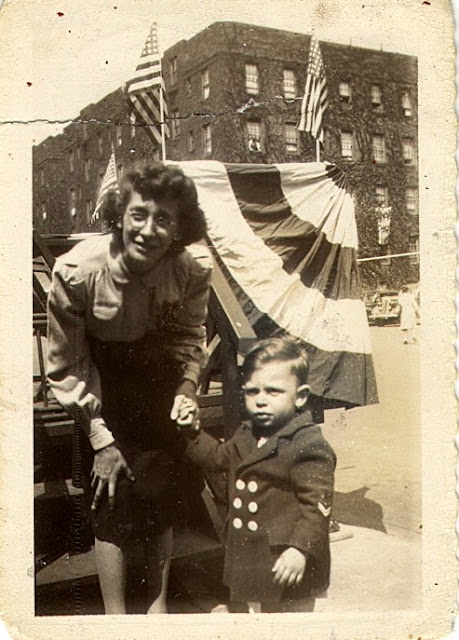
Finally, some of you may have noticed the snapshot of me in the sidebar at the age of 2 or 3. As part of my ongoing week-long 83rd birthday celebration, here is the full original photograph revealing that it was my mother who was holding my hand:
P.S. - The title of this post is also the title of a song written by Cole Porter (1891-1964).
MSRP
GMO
AOC
CIDP
TED
NTSB
For the uninformed, the confused, and yes, even the dazed whose knowledge of abbreviations is limited to the IRS, LBJ, and the wearing of BVDs, I will now tell you what the above six abbreviations stand for:
Manufacturer's Suggested Retail Price
Genetically Modified Organisms
Alexandria Ocasio-Cortez
Chronic Inflammatory Demyelinating Polyneuropathy
Thyroid Eye Disease
National Transportation Safety Board
A portion of the American population are convinced that Anastasia Ocasio-Cortez is herself a genetically modified organism, but I digress.
Moving right along, I saw a commercial on television for a product called Relaxium. Although it sounds like it might be an antidote for an overdose of Viagra, it is actually a sleep aid. The commercial opens with a man saying, "Hello, I'm former Arkansas Governor Mike Huckabee". In another version of the commercial the man says, "Hello, I'm former governor of Arkansas, Mike Huckabee". The second version is true but the first version is not. Mke Huckabee is the former governor of Arkansas but he is not now nor has he ever been the governor of former Arkansas. You do see the difference, don't you?
So I pass my days, being literal to a fault. I listen carefully to what is said as opposed to what might have been meant. The stated aim of the Society For Techical Communication back in the 1970s was that every sentence have one meaning, understood at the first reading. It is still my personal goal. In other words, friends, Ambiguity R Not Us.
Finally, some of you may have noticed the snapshot of me in the sidebar at the age of 2 or 3. As part of my ongoing week-long 83rd birthday celebration, here is the full original photograph revealing that it was my mother who was holding my hand:

P.S. - The title of this post is also the title of a song written by Cole Porter (1891-1964).
Saturday, March 16, 2024
My new favorite poem
...is the following one, purportedly by Billy Collins:
Another Reason Why I Don't Keep A Gun In The House
The neighbors' dog will not stop barking.
He is barking the same high, rhythmic bark
that he barks every time they leave the house.
They must switch him on on their way out.
The neighbors' dog will not stop barking.
I close all the windows in the house
and put on a Beethoven symphony full blast
but I can still hear him muffled under the music,
barking, barking, barking,
and now I can see him sitting in the orchestra,
his head raised confidently as if Beethoven
had included a part for barking dog.
When the record finally ends he is still barking,
sitting there in the oboe section barking,
his eyes fixed on the conductor who is
entreating him with his baton
while the other musicians listen in respectful
silence to the famous barking dog solo,
that endless coda that first established
Beethoven as an innovative genius.
(end of poem)
I say purportedly because I could not find that title in a list of the complete poems of Billy Collins at Poetry Foundation. To be fair, however, I do not know when the list was compiled and Billy Collins, who is still alive and kcking, may well have written the poem since the list was put together, in which case the list needs to be updated.
I laughed when I read the poem and thought about the two big dogs, Rebel and Jasper, who live behind my next-door neighbor's fence. They go ballistic every time I take Abby out our back door. They sound ferocious, like they want to eat her if they could just get to her, and maybe me as well. Abby seems to enjoy setting them off but I do grow weary of the scenario.
I said to Mrs. RWP (the lovely Ellie), "Want to hear something crazy?" and read the poem aloud to her. She agreed that it was crazy, and I said, "I know! It's good but it's crazy! I think I'm crazy sometimes but I finally found someone crazier than me!"
Billy Collins and I are practically twins as we were both born in March 1941. Both of us turn 83 next week, me (I?) on Monday and him (he?) on Friday. Both of us write poems, some of them crazy. There is one minor difference between us, though. Billy Collins served as Poet Laureate of the United States from 2001 to 2003; I have yet to be asked.
Another Reason Why I Don't Keep A Gun In The House
The neighbors' dog will not stop barking.
He is barking the same high, rhythmic bark
that he barks every time they leave the house.
They must switch him on on their way out.
The neighbors' dog will not stop barking.
I close all the windows in the house
and put on a Beethoven symphony full blast
but I can still hear him muffled under the music,
barking, barking, barking,
and now I can see him sitting in the orchestra,
his head raised confidently as if Beethoven
had included a part for barking dog.
When the record finally ends he is still barking,
sitting there in the oboe section barking,
his eyes fixed on the conductor who is
entreating him with his baton
while the other musicians listen in respectful
silence to the famous barking dog solo,
that endless coda that first established
Beethoven as an innovative genius.
(end of poem)
I say purportedly because I could not find that title in a list of the complete poems of Billy Collins at Poetry Foundation. To be fair, however, I do not know when the list was compiled and Billy Collins, who is still alive and kcking, may well have written the poem since the list was put together, in which case the list needs to be updated.
I laughed when I read the poem and thought about the two big dogs, Rebel and Jasper, who live behind my next-door neighbor's fence. They go ballistic every time I take Abby out our back door. They sound ferocious, like they want to eat her if they could just get to her, and maybe me as well. Abby seems to enjoy setting them off but I do grow weary of the scenario.
I said to Mrs. RWP (the lovely Ellie), "Want to hear something crazy?" and read the poem aloud to her. She agreed that it was crazy, and I said, "I know! It's good but it's crazy! I think I'm crazy sometimes but I finally found someone crazier than me!"
Billy Collins and I are practically twins as we were both born in March 1941. Both of us turn 83 next week, me (I?) on Monday and him (he?) on Friday. Both of us write poems, some of them crazy. There is one minor difference between us, though. Billy Collins served as Poet Laureate of the United States from 2001 to 2003; I have yet to be asked.
Thursday, March 14, 2024
I wonder as I wander
When and why did people start saying 'from here to Timbuktu'? Why don't they say 'from here to Tegucigalpa' or 'from here to Ouagadougou' or 'from here to Ulaanbaatar' or even 'from here to Kealikakua, Hawaii, where the humuhumunukunukuapua'a go swimming by' instead?
Although careful readers of the previous paragraph know that Kealikakua is in Hawaii, how many of them can match the other four places with their countries?
Why do people in the northern states say "I don't know [person's name] from Adam's off ox" but prople in the southern states say "I don't know [person's name] from Adsm's house cat"?
Why do fools fall in love?
Oh where, oh where has my little dog gone? Oh where, oh where can he be? With his ears cut short and his tail cut long, oh where, oh where can he be?
Does your chewing gum lose its flavor on the bedpost overnight?
Who is Sylvia?
Although careful readers of the previous paragraph know that Kealikakua is in Hawaii, how many of them can match the other four places with their countries?
Why do people in the northern states say "I don't know [person's name] from Adam's off ox" but prople in the southern states say "I don't know [person's name] from Adsm's house cat"?
Why do fools fall in love?
Oh where, oh where has my little dog gone? Oh where, oh where can he be? With his ears cut short and his tail cut long, oh where, oh where can he be?
Does your chewing gum lose its flavor on the bedpost overnight?
Who is Sylvia?
Subscribe to:
Posts (Atom)